Mark Up a Draft Agreement Before You Sign Anything
Key takeaways
- Highlighting is a dragged rectangle, so it works on scans too
- Notes do not wrap: keep each one to five or six words
- Nothing is saved until you download, and a refresh loses everything
- Marks are baked into the page, so the other side cannot delete them
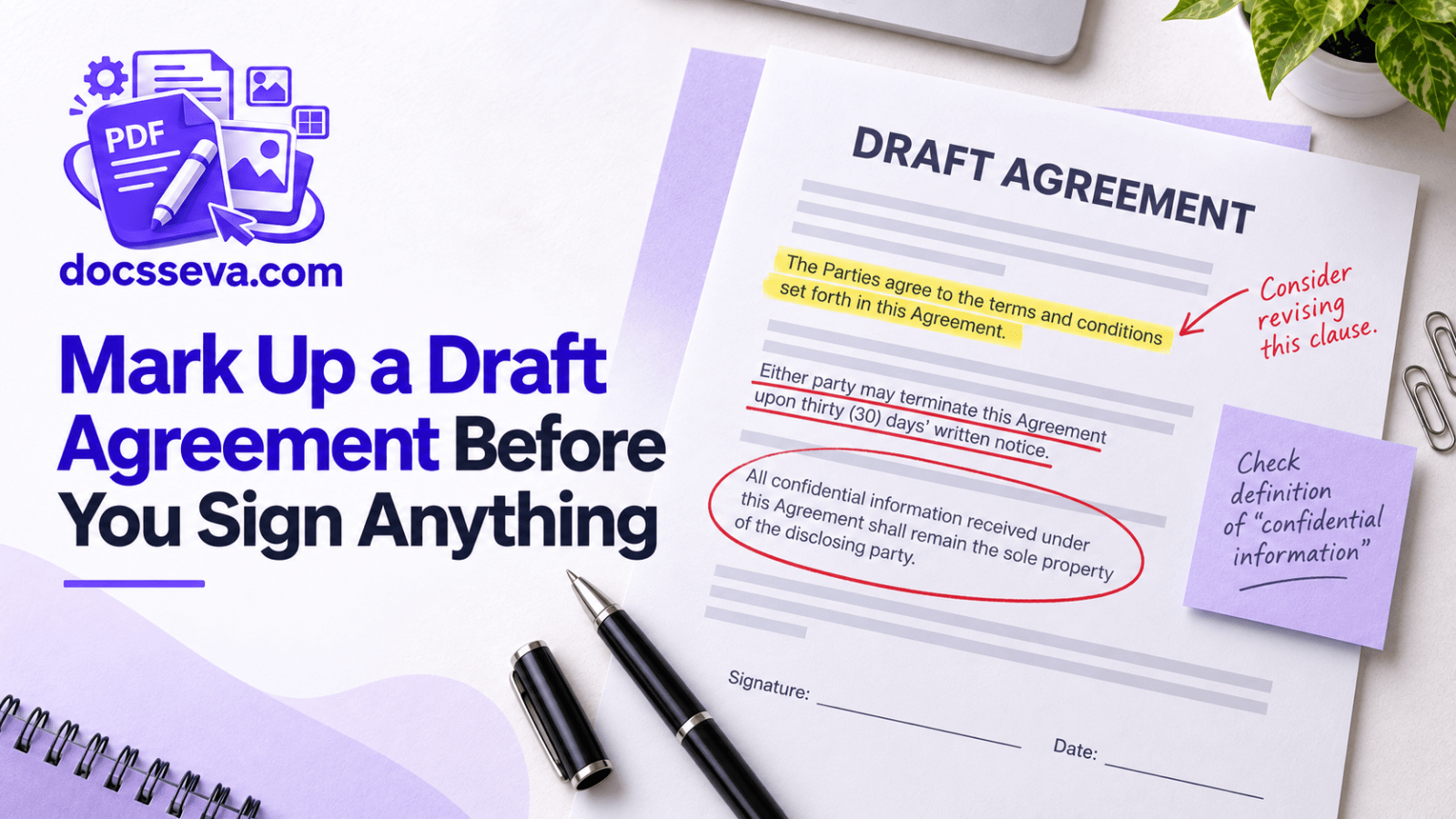
The builder's office sends the draft sale agreement at 11 pm and wants it back "with your points" by tomorrow. Eleven pages. Clause 7 has a possession date that does not match what was discussed, the payment schedule has an extra instalment, and there is a maintenance charge nobody mentioned.
Writing an email listing your objections is how this normally goes, and it is how things get missed — the other side reads the email, opens the document, and cannot find what you were talking about. Marking the points on the document itself, in the exact places, removes that gap entirely.
Getting it open
Drop the PDF into the PDF Annotator. It renders the first page on screen and shows a page counter underneath with Prev and Next buttons. Files up to 100 MB are accepted, which covers any agreement — an eleven-page contract is usually well under two megabytes unless it was scanned.
If it will not open, check whether it is password-protected. A locked file has to be opened before it can be marked, so run it through PDF Unlock with the password first.
The whole thing happens in the browser tab. Nothing is uploaded, which for a document containing your name, the property details and your payment schedule is the correct arrangement.
Four tools, and what each one is actually for
The toolbar has Highlight, Text note, Draw and Eraser, plus four colours: yellow, green, blue and pink.
Highlight is a drag, not a text selection. You press down at one corner of the area you want and drag to the other, and it fills that rectangle at 30% opacity in your chosen colour. This matters more than it sounds: because it is a rectangle over the page rather than a selection of text characters, it works exactly the same on a scanned agreement as on a digital one. Most highlighting tools give up on scans. This one does not know the difference.
The trade-off is that it will not snap to a line of text for you. Drag along the line and keep the box a little taller than the text so it looks intentional.
Text note places typed text on the page. Click where you want it, type in the box that appears, and the words are drawn at that spot in 12 pt of your chosen colour. Two things to know: it is not a folded sticky note that opens on click, it is text sitting on the page, and it does not wrap. A long note runs off the right edge of the page and vanishes. Keep each one to five or six words and put several down the margin rather than one long sentence. Double-click an existing note to change its wording.
Draw is freehand — a 2 pt line in the current colour that follows your pointer. On a laptop trackpad it is scrappy, on a phone or tablet with a finger it is fine. Use it for circling a figure, striking through a clause, or an arrow from a note to the line it refers to.
Eraser removes a whole mark. Switch to it and click any highlight, note or drawing and it is gone. It is not a partial rubber — it deletes the mark you clicked, not the bit you dragged over.
A colour convention that saves an argument
The four colours are only useful if they mean something. Agree the meanings with yourself before you start and stay consistent:
| Colour | Meaning |
|---|---|
| Pink | Must change before I sign |
| Yellow | Explain this to me |
| Blue | My comment or counter-proposal |
| Green | Agreed, no issue |
Then put one note on page one that says what the colours mean. The person reading it at the other end will follow the document instead of hunting through an email. Green is worth using generously, incidentally — a draft that comes back with only objections marked reads as hostile, and one that shows what you accepted reads as a negotiation.
Working through it
Go page by page with Next rather than jumping around. The counter above the canvas shows how many annotations are on the page you are looking at, which is a quick way to check you have not left a page you meant to mark.
For the possession date in clause 7: highlight the date in pink, then place a blue note beside it reading "agreed 31 Mar 2027". Six words. It fits, it is unambiguous, and the person reading it does not need your email open.
For the extra instalment: highlight the row in pink, draw a line through it, note "not in the booking letter".
For the maintenance charge: yellow highlight, note "what does this cover?".
That is a marked draft. It took eight minutes and every point is attached to the exact line it belongs to.
Save it before you close the tab
There is no autosave and no draft stored anywhere. Everything you have marked lives in the open tab. Refresh the page, close it by accident, let the phone kill the browser in the background — the marks are gone and the original file is untouched, which means starting over.
Press download and you get the marked file back with an -annotated suffix on the original name. Do that at the end of every working session, not only when you have finished the whole document.
What arrives is a normal PDF with your marks drawn into the pages. They are baked in, not attached as clickable annotation objects, so the other side cannot select a highlight and delete it, and they cannot reply to a note inside the file. For sending comments back on a draft, that is exactly right — it is your marked copy, and it stays marked.
The two limits to plan around
Notes are Latin characters only. The text is drawn with the standard Helvetica built into the PDF format. A note typed in Hindi or Marathi will not export. Write comments in English, or write your points in your own language in a separate covering note and use the highlights to point at the clauses.
One long note does not fit. Because there is no wrapping, the practical ceiling is around eight words at 12 pt starting from the left margin — less if you place the note halfway across the page. Three short notes stacked down the margin work far better than one sentence that disappears off the edge.
After the marking
If the agreement came as several separate PDFs — the draft, the annexures, the booking letter — mark each one and then join them for sending with PDF Merger, so the builder's office receives one file in the order you want it read.
If the marked file is too large for email, PDF Compressor will bring it down. And when the negotiation is finished and you are signing rather than commenting, the mark you want is a different one — PDF Stamp puts a drawn signature or an initial in a specific place on a specific page, which is a different job from marking up a draft.
Both live under editors along with the rest of the marking tools.
DocsSeva Team
Published on September 15, 2026
Browse all tools
29+ free document tools, no account required.
Browse all toolsMore on pdf-markup
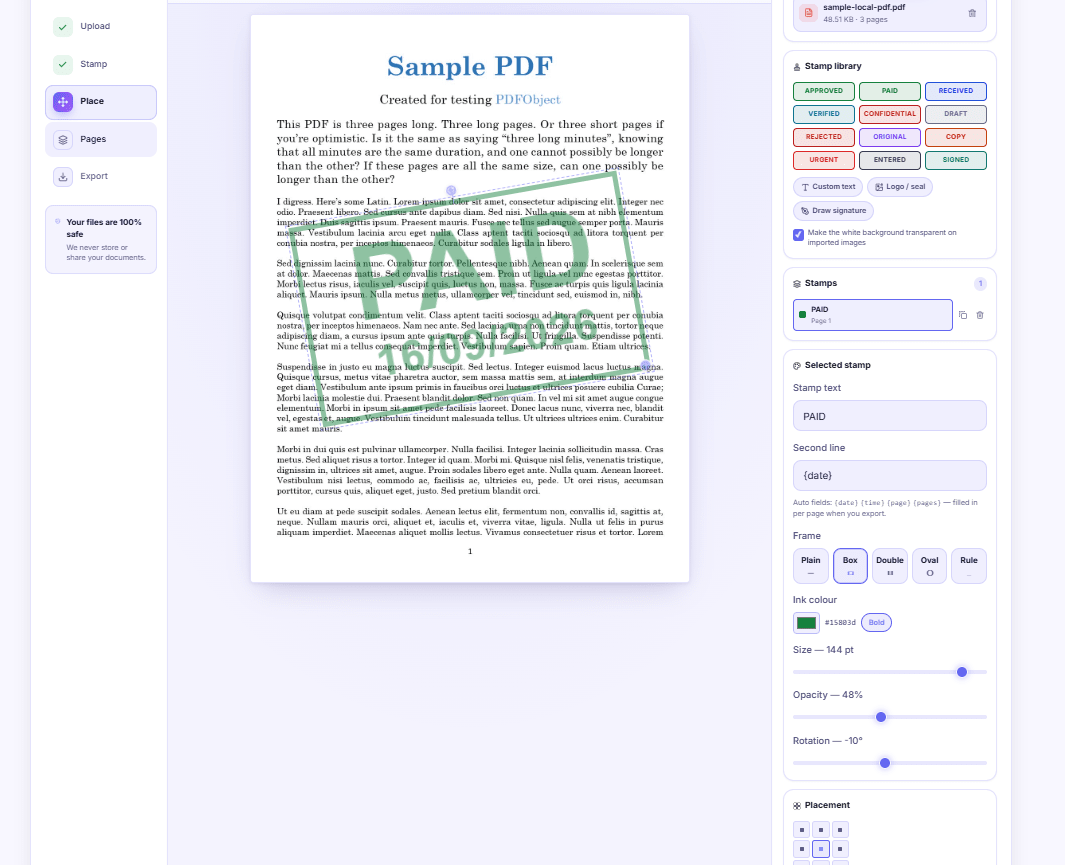
Stamp PAID on an Invoice Without Printing It First
Drop a dated PAID stamp onto an invoice PDF, or photograph your own rubber stamp and place the ink itself. A walkthrough for anyone without a printer and scanner.
High-Intent Comparison
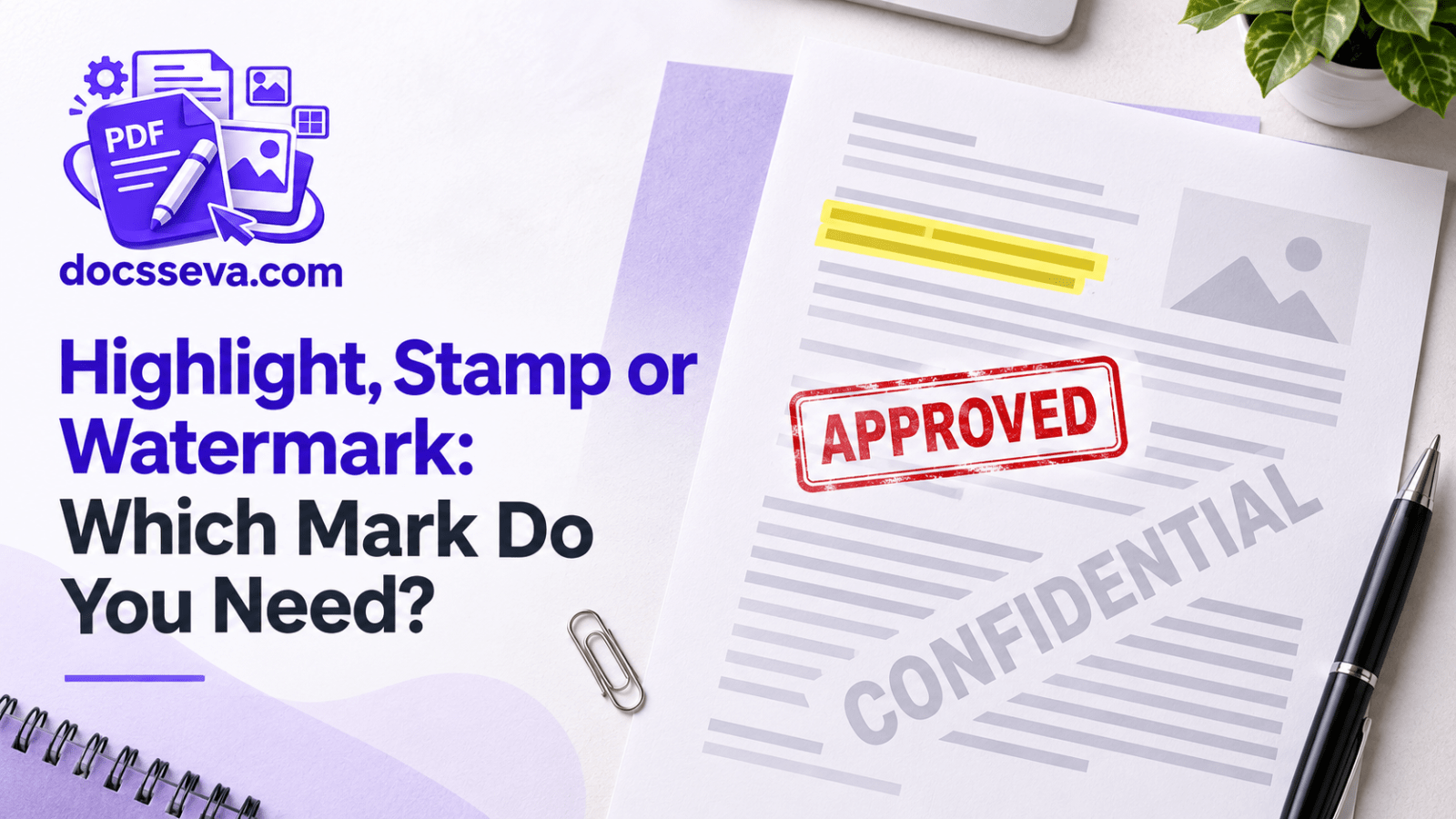
Highlight, Stamp or Watermark: Which Mark Do You Need?
Annotations answer what you think, stamps record what happened, watermarks say what the document is. A side-by-side comparison, including which marks can be undone.
Number Every Page of a PDF Bundle Before You File It
Merge, then stamp Page {page} of {pages} across the whole bundle in one pass, add an initial on every sheet, and handle double-sided printing properly.