The PDF Watermarks a Remover Genuinely Cannot Erase
Key takeaways
- Cleaning keeps dark and colourful pixels on purpose
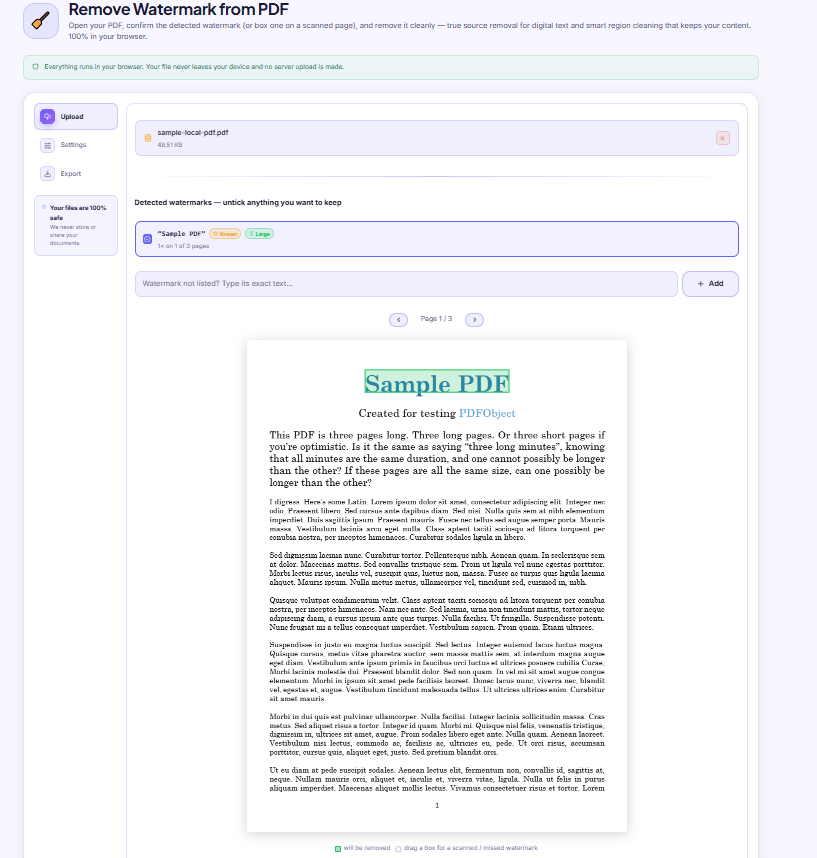
- An empty detection list means there is no text watermark to delete
- Long footer lines are filtered out but can be typed in manually
- Removing a seller's SAMPLE mark is not a workflow problem, it is theft
You load the file, the checklist comes up empty, you draw a box over the offending logo anyway, press remove — and the logo is still there. Fainter, maybe. Still there.
There is a real boundary around what any watermark remover can do, and it is not a matter of trying harder or paying for a better tool. It comes from what the mark is made of and what sits underneath it. Knowing which side of that line your file falls on saves an hour of poking at it.
The rule the cleaner follows
When a watermark cannot be deleted from the page instructions, the PDF Watermark Remover falls back to cleaning the pixels. That cleaning is not intelligent and does not try to be. It walks every pixel in the region and applies one test:
- If the pixel is colourful — saturation above roughly a third — leave it alone. That is your logo, your chart, your blue hyperlink, your red seal.
- If the pixel is dark — brightness below about 148 out of 255 — leave it alone. That is your text.
- If the pixel is pale and washed out — brightness above 180 — push it to white.
- If it falls in the band between, fade it towards white proportionally, so edges do not turn into a hard step.
That rule is the whole engine, and it is deliberately conservative. A watermark is typically pale grey and desaturated; body text is dark; content is coloured. Keeping the second and third categories is what stops the tool eating your document. Which also means anything that looks like content survives, whether or not you wanted it to.
Four watermarks it will not lift
1. A bold, dark watermark. A near-black SPECIMEN across the page is, to that test, indistinguishable from a heading. Lift it and every letter of your body text lifts with it, leaving a blank page. The tool refuses, correctly. If the phrase is real text, the source-deletion pass may still handle it — but if it is an image or an outlined shape, a dark watermark stays.
2. A strongly coloured logo. A saturated red or blue company mark is above the saturation threshold and is preserved by design. Ask yourself which you would rather have: a tool that keeps your coloured content, or one that strips it whenever it decides the colour looks decorative.
3. A watermark over dark content. Even where the mark itself is pale, wherever it crosses black text there is nothing to recover. The pixels under those letters were never captured — the letter is on top. Cleaning the pale bits around it leaves the crossing points looking chewed. On a page with a lot of text, this shows.
4. A watermark baked into a photograph. A scanned page, a phone photo of a printed document, a screenshot. The mark is now part of the same image as the content, at the same brightness range as the paper's own grey. Cleaning that region will lift the mark and also lift the grey of the paper, and often some of the fainter print with it.
Why the checklist sometimes comes up empty
The detection stage looks for structural evidence, not for the word "watermark". A phrase becomes a candidate when it is rotated between 8 and 172 degrees, or averages 36 pt or larger, or repeats five or more times, or appears on at least 60% of the pages. It also matches against a list of the usual suspects — CONFIDENTIAL, DRAFT, SAMPLE, DO NOT COPY, COPY, INTERNAL USE ONLY, PROPRIETARY, FOR REVIEW, PREVIEW, UNREGISTERED, EVALUATION, TRIAL, SPECIMEN, VOID, ORIGINAL, DUPLICATE.
Two things get filtered out on purpose:
- Anything long. More than six words, or more than 45 characters, is treated as a real sentence rather than a stamp. That is why "Downloaded by rakesh.k on 24 August 2026 — not for redistribution" running along the bottom of every page will not be offered to you automatically. Type the exact phrase into the manual box and it becomes a target.
- Anything that is only a phrase match. If the word DRAFT appears in your document at normal size and normal angle, it is listed but not pre-ticked. It has to be structurally odd — rotated, oversized, tiled — before the tool ticks it for you. A document about watermarking should not lose its own body text.
An empty checklist tells you something useful: there is no extractable text watermark on this file. It is an image, an outline, or part of a scan, which means only the pixel route is available and the four limits above apply.
What to do instead
If the file is one page and appearance is all that matters, convert the pages to images with PDF to Images, fix them properly in an image editor, and rebuild the document with Images to PDF. Slower, but you are working with the real problem — pixels — rather than asking a document tool to solve it.
If the source is a JPG or PNG rather than a PDF, use Image Watermark Remover directly. Feeding an image into a document tool adds a conversion step for nothing.
If the PDF is encrypted, nothing will work until it is opened. Processing fails outright on a locked file. Run it through PDF Unlock with the password first.
If only some pages are affected, consider whether you need the rest of the document at all. PDF Extractor pulls the pages you want into a new file, which keeps the damage contained to the pages that actually needed cleaning.
The part nobody wants in the article
Some watermarks are there for a reason, and removing them is the wrong thing to do regardless of whether it is technically possible.
A SAMPLE across a paid template, a PREVIEW across a stock photograph, a licence stamp on a study guide someone sells for a living — those marks are the seller's business model. Stripping them is not a workflow problem, it is taking something you did not pay for. The legitimate uses are the ordinary ones: your own DRAFT stamp from a document you wrote, a CONFIDENTIAL mark that has expired, an internal label on a report your own office produced and is now publishing.
Worth saying because the tools do not know the difference and never will. The judgement is yours.
A quick way to know before you start
Open the PDF in any reader and try to select the watermark text with your mouse. If you can select it and copy it out, it is real text, source deletion will probably work, and your pages stay searchable. If you cannot, you are in pixel territory and the four limits apply — which is worth knowing before you spend twenty minutes on it rather than after.
Everything else for document work sits under PDF tools, including the splitting, merging and conversion steps you will need if the pixel route turns out to be the only one open to you.
DocsSeva Team
Published on September 17, 2026
Browse all tools
29+ free document tools, no account required.
Browse all toolsMore on watermarks
High-Intent Comparison
Highlight, Stamp or Watermark: Which Mark Do You Need?
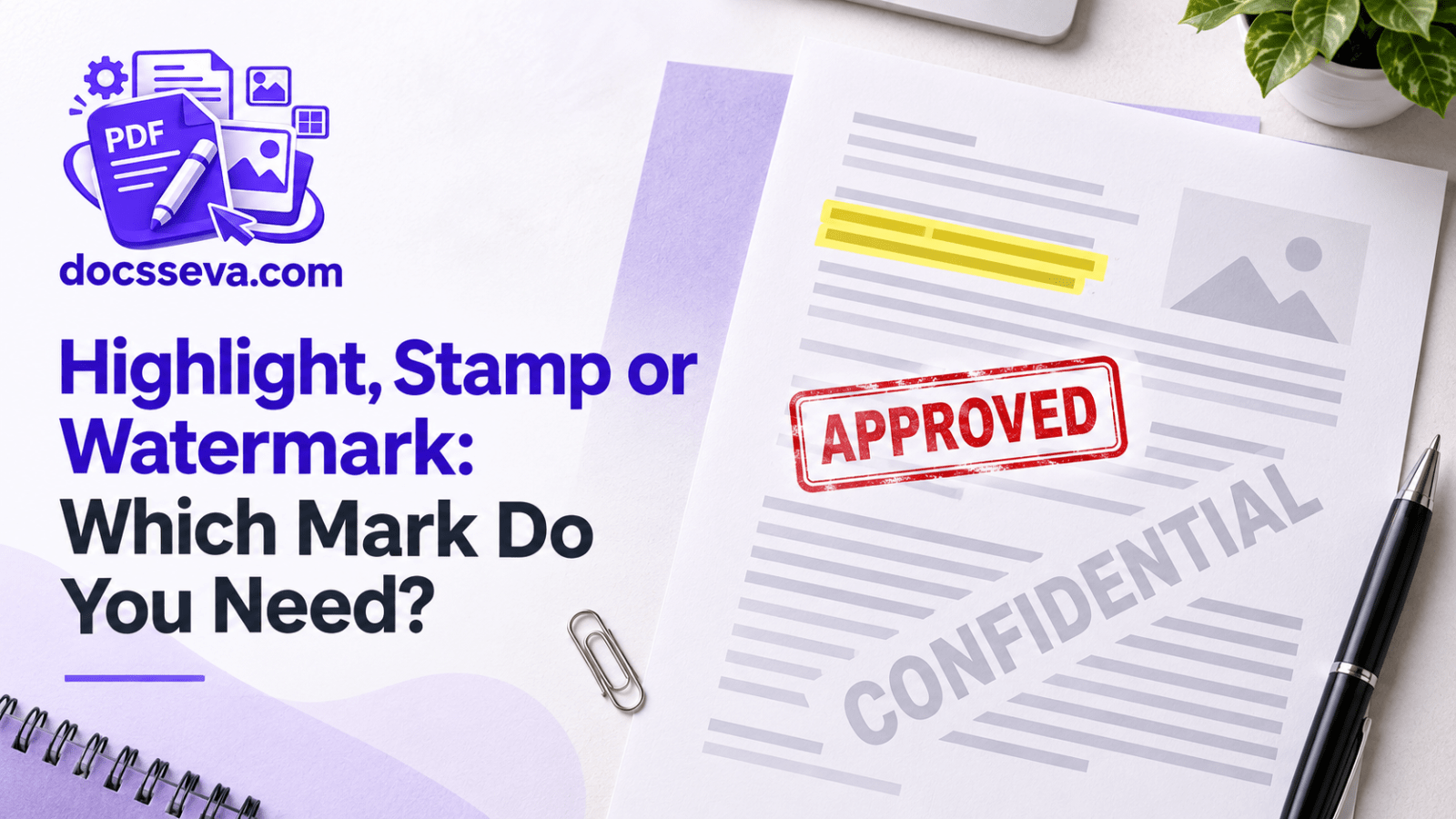
Annotations answer what you think, stamps record what happened, watermarks say what the document is. A side-by-side comparison, including which marks can be undone.
Your Merged PDF Came Out in the Wrong Order? Fix It
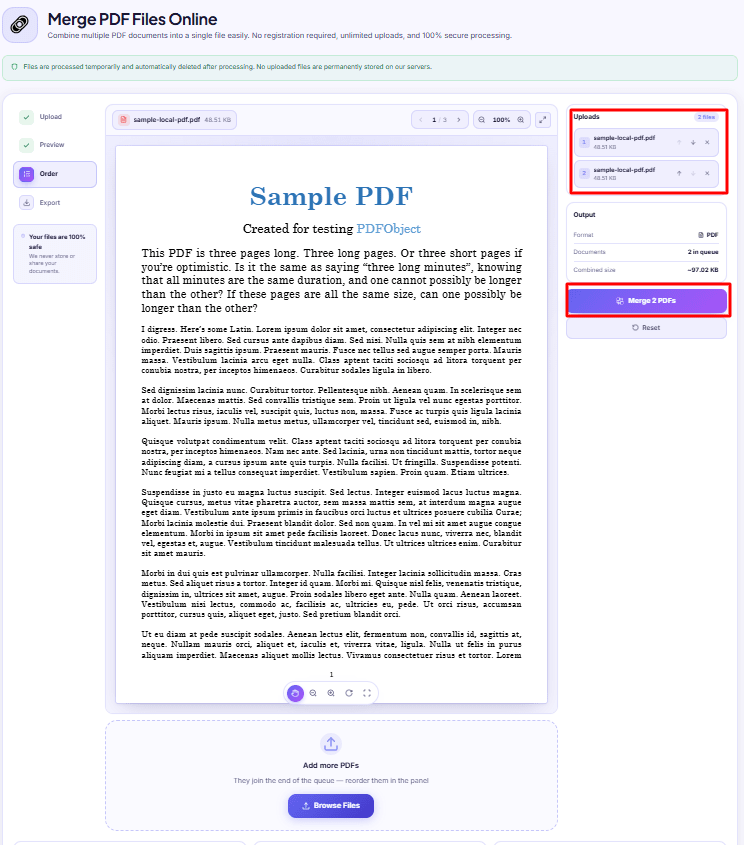
Merged PDFs almost always come out jumbled for one reason: the queue order. Here is why filenames betray you and how to fix the sequence before you merge.
Combine Aadhaar, PAN and Mark Sheets Into One PDF
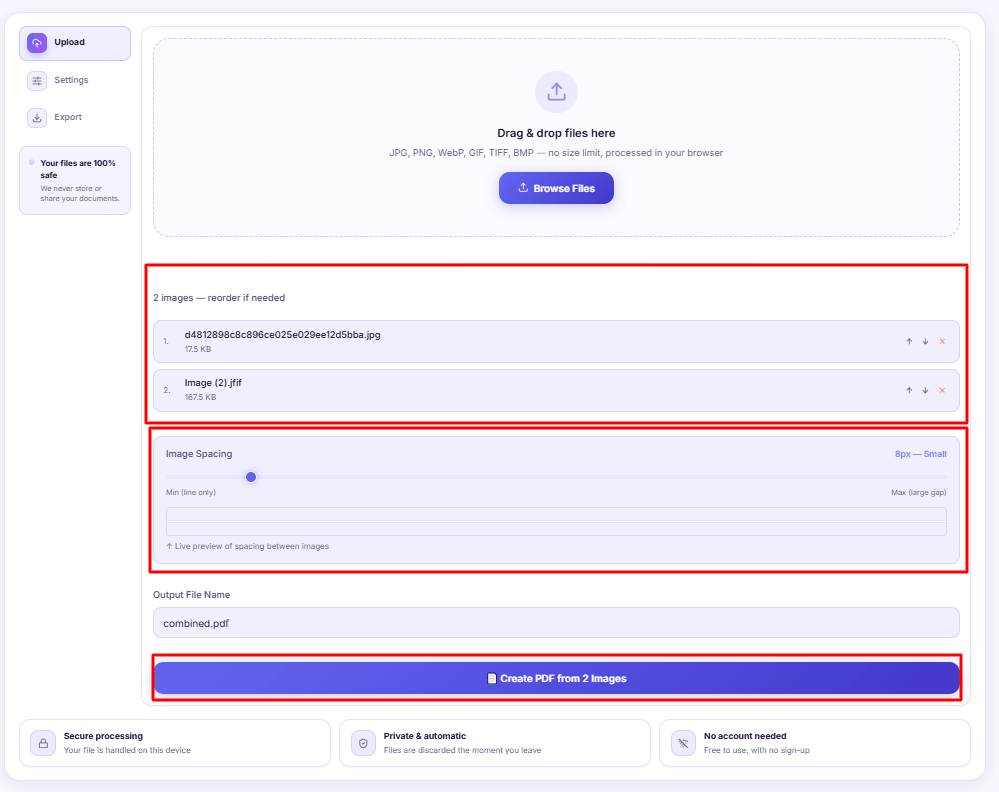
A step-by-step way to turn phone photos, downloaded PDFs and cyber-cafe scans into one document bundle that fits a portal's 2 MB upload limit.