Why Your PDF Text Stops Selecting After Watermark Removal
Key takeaways
- Source deletion keeps pages vector and searchable
- Region cleaning replaces the page with a 2x image
- The report line 'cleaned N regions' counts the rasterised pages
- Running the result through OCR restores search but not certainty
The SAMPLE stamp is gone, the pages look right, and then you press Ctrl+F to find a clause number and the search finds nothing. Not on those pages. Select the text with the mouse and nothing highlights either — the paragraph has turned into a picture of a paragraph.
This is not a bug and it is not random. It happens on exactly the pages where the watermark could not be deleted at the source, and the removal report tells you which pages those were, if you know what the lines mean.
Two completely different jobs, one button
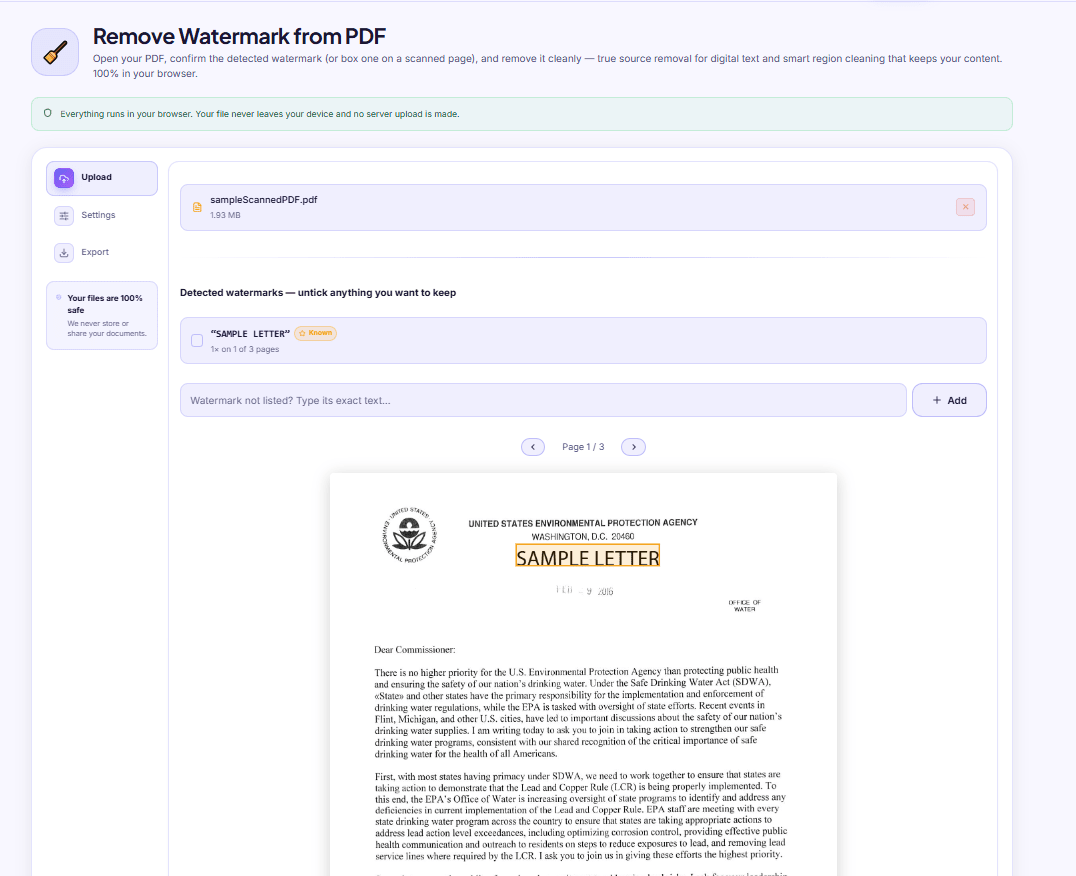
The PDF Watermark Remover tries the surgical approach first and falls back to the blunt one only where it has to.
Pass one is source removal. A PDF page is a list of drawing instructions, and a text watermark is a handful of show-text operators in that list. The tool finds the ones that draw your watermark phrase and deletes only those instructions, leaving every other byte of the page untouched. Nothing is redrawn, nothing is re-encoded. The page after removal is the page before removal minus one word, and all your real text stays exactly as selectable and searchable as it was.
Pass two is region cleaning. When the watermark cannot be deleted from the instruction list, the page is rendered to a canvas at double scale, the watermark is lifted off the pixels by brightness, and the cleaned image is drawn back over the page. That works no matter how the watermark was encoded, because at that point it is just light grey pixels on white. The cost is that the page you get back is an image.
Same button, same document, often both passes in one run — some pages handled surgically, others rasterised.
Why pass one fails on some files
It comes down to how the text is encoded, which you have no control over and cannot see.
- Custom subset fonts with CID encoding. The document embeds its own font and refers to glyphs by internal index rather than by character. The bytes in the content stream that draw the word SAMPLE do not contain the letters S, A, M, P, L or E anywhere, so a phrase match cannot find them. The watermark is visible on screen because the viewer resolves it through the font's mapping; the removal pass looks at the raw stream and sees nothing to match.
- Text converted to outlines. Some export pipelines turn watermark text into vector shapes. There is no text left to delete — it is a drawing of letters.
- Image watermarks. A logo or a scanned stamp is a picture, not text, and always falls to pass two.
- Flattened scans. If the whole page is a scan, the watermark is part of the same photograph as your content.
The tool does not guess about this. After the deletion pass it re-opens the half-finished file, reads the text back off every page, and checks whether the watermark still renders. Pages where it is gone are left alone, vector and selectable. Pages where it is still there go to the raster pass. That verification step is why the result is consistent — you never get a page that looks clean in one viewer and stamped in another.
Reading the report
When it finishes, the panel lists what happened in three lines. This is the part worth reading before you download:
| Report line | What it means for your file |
|---|---|
| Deleted N watermark text instance(s) at the source | Pass one worked. Those pages are untouched otherwise, still searchable. |
| Removed N watermark annotation(s) | The watermark was a separate annotation object, unhooked cleanly. No quality cost. |
| Cleaned N watermark region(s) while preserving content | Pass two ran on N pages. Those N pages are now images. |
| Nothing matched | Neither pass had a target. Tick a different candidate or draw a box. |
If the third line reads zero, your file came through completely intact and there is nothing to worry about in this article. If it reads 12, twelve pages of your document are now pictures.
What you actually lose
The word "raster" understates it, so here is the list:
- Text search stops working on those pages.
- Copying text out stops working. If you needed the wording, pull it out first with PDF Text Extract before you remove anything.
- Screen readers get nothing.
- File size goes up, sometimes a lot — a page of plain text might be a few kilobytes as vector and a few hundred as a 2x PNG.
- Reflow, tagging and any accessibility structure are gone.
What you do not lose is appearance. The clean is done at double the page resolution, so on screen and in normal printing it looks the same as before.
Getting the text back
You cannot undo the rasterisation, but you can put a text layer back underneath the image. Run the cleaned file through PDF OCR and it recognises the words on those pages and stores them as an invisible layer behind the picture. Search works again, copy works again, and the visible page is unchanged.
The catch is that OCR is recognition, not recovery. It will be right about ordinary body text and occasionally wrong about a serial number, a poorly printed digit or a table with tight columns. If those exact strings matter, check them — do not assume a recovered text layer is as reliable as the original.
For the file size, PDF Compressor handles the rasterised pages the way it handles any image-heavy PDF, which is far better than it handles vector text.
Keeping more pages on the vector path
A few habits genuinely help.
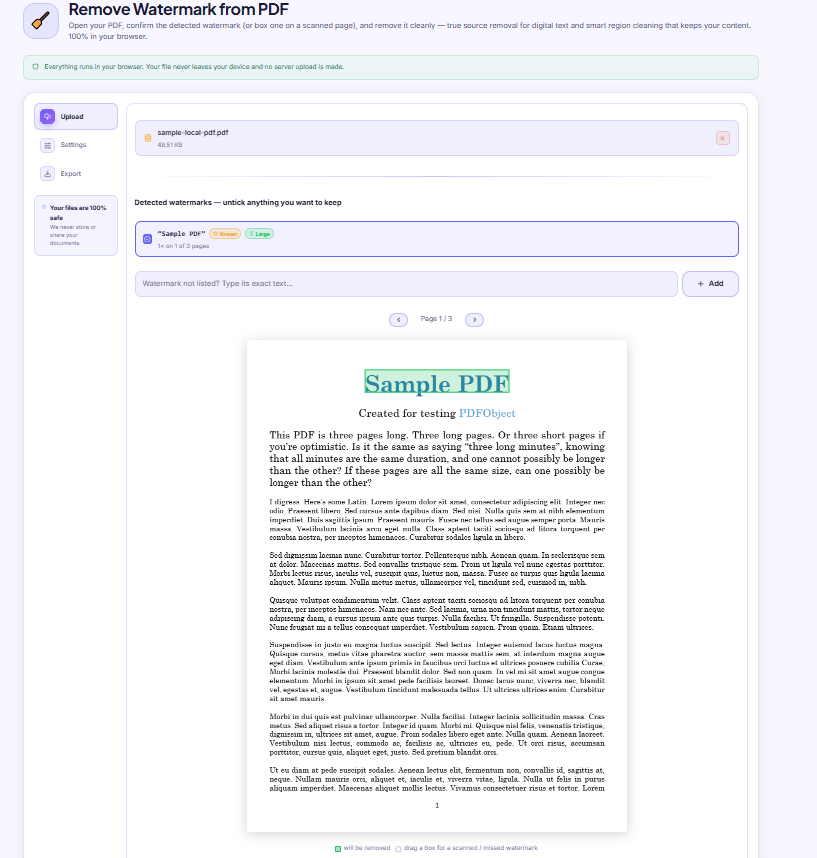
Start with the checklist, not the box tool. When the file loads, detected watermarks appear as a list with badges — Diagonal, Every page, Large, Known — and the confident ones are pre-ticked. If the phrase is listed and it is real text, ticking it and pressing remove gives pass one a chance. Drawing a box instead forces pass two on that page whether or not the text could have been deleted cleanly.
Type the exact phrase if it is missing. The manual box takes an exact string, matched without case sensitivity. A watermark reading "Sample Copy" is found by typing sample copy. Getting the phrase right is what lets the surgical pass work.
Untick anything you want kept. A candidate appearing on 60% of pages might be a running header, not a watermark. Removing a header you actually wanted means running the whole job again from the original file.
Do not re-run for no reason. The Continue Editing button feeds the already-processed file back in, which is useful for a second watermark you missed. But a page that was rasterised in round one is an image in round two, so anything you do to it after that is pixel work.
When rasterising is fine
Plenty of documents do not care. A certificate you need to print. A scanned invoice that had no text layer to begin with. A one-page form heading for the printer. If the file's only future is being looked at and printed, the difference is invisible and you can ignore all of this.
It matters for long documents someone has to work with — contracts people search, reports people quote from, anything going into a system that reads text out of PDFs. For those, check the report line before you download, and if it says half the document was cleaned, consider whether removing the watermark is worth turning a searchable file into a stack of pictures.
If the watermark you are fighting is on an image rather than a PDF, that is a different tool — Image Watermark Remover works on JPGs and PNGs directly. Everything else for documents is listed under PDF tools, and the full set is on all tools.
DocsSeva Team
Published on September 18, 2026
Browse all tools
29+ free document tools, no account required.
Browse all toolsMore on watermarks
The PDF Watermarks a Remover Genuinely Cannot Erase
Dark stamps, saturated logos, marks over black text and watermarks baked into scans. The four cases no PDF watermark remover can clean, and what to do instead.
Your Merged PDF Came Out in the Wrong Order? Fix It
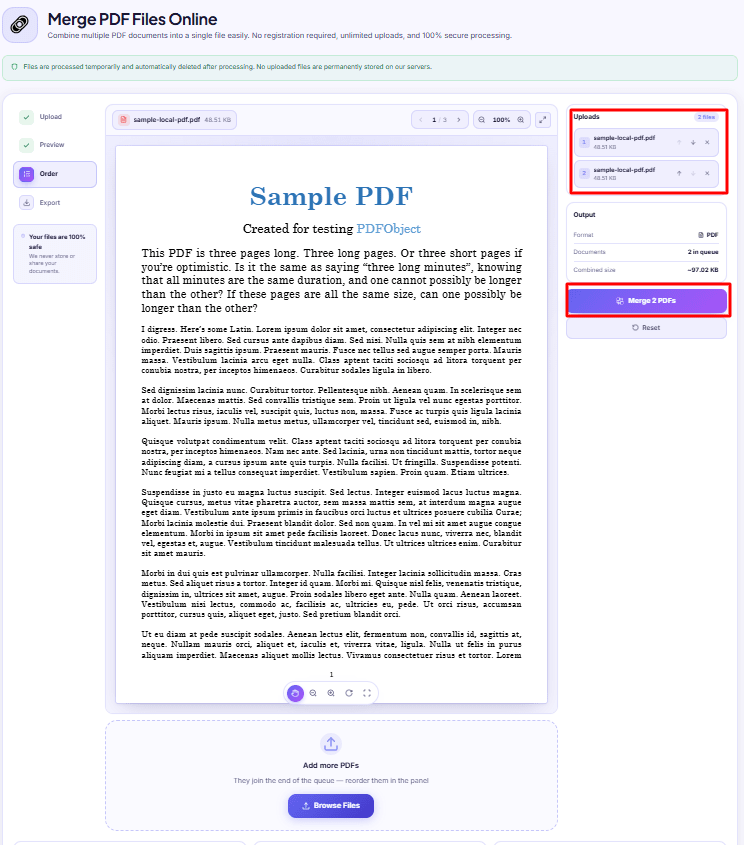
Merged PDFs almost always come out jumbled for one reason: the queue order. Here is why filenames betray you and how to fix the sequence before you merge.
Combine Aadhaar, PAN and Mark Sheets Into One PDF
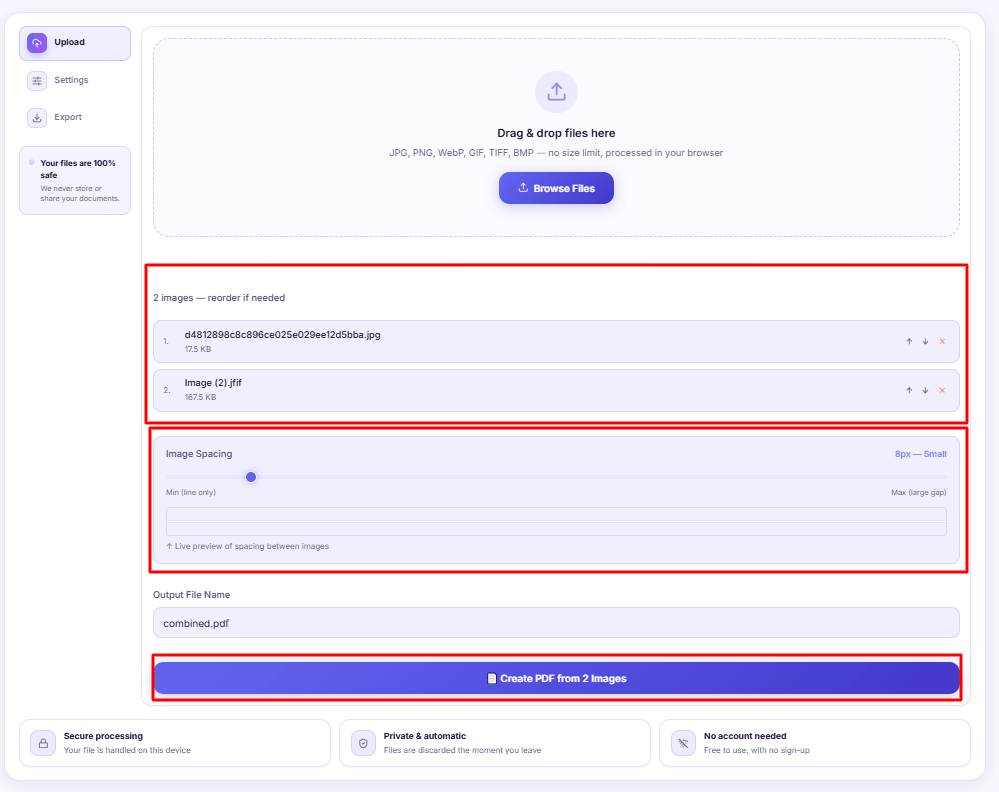
A step-by-step way to turn phone photos, downloaded PDFs and cyber-cafe scans into one document bundle that fits a portal's 2 MB upload limit.