How to Compress a PDF Online for Free: Step-by-Step Guide
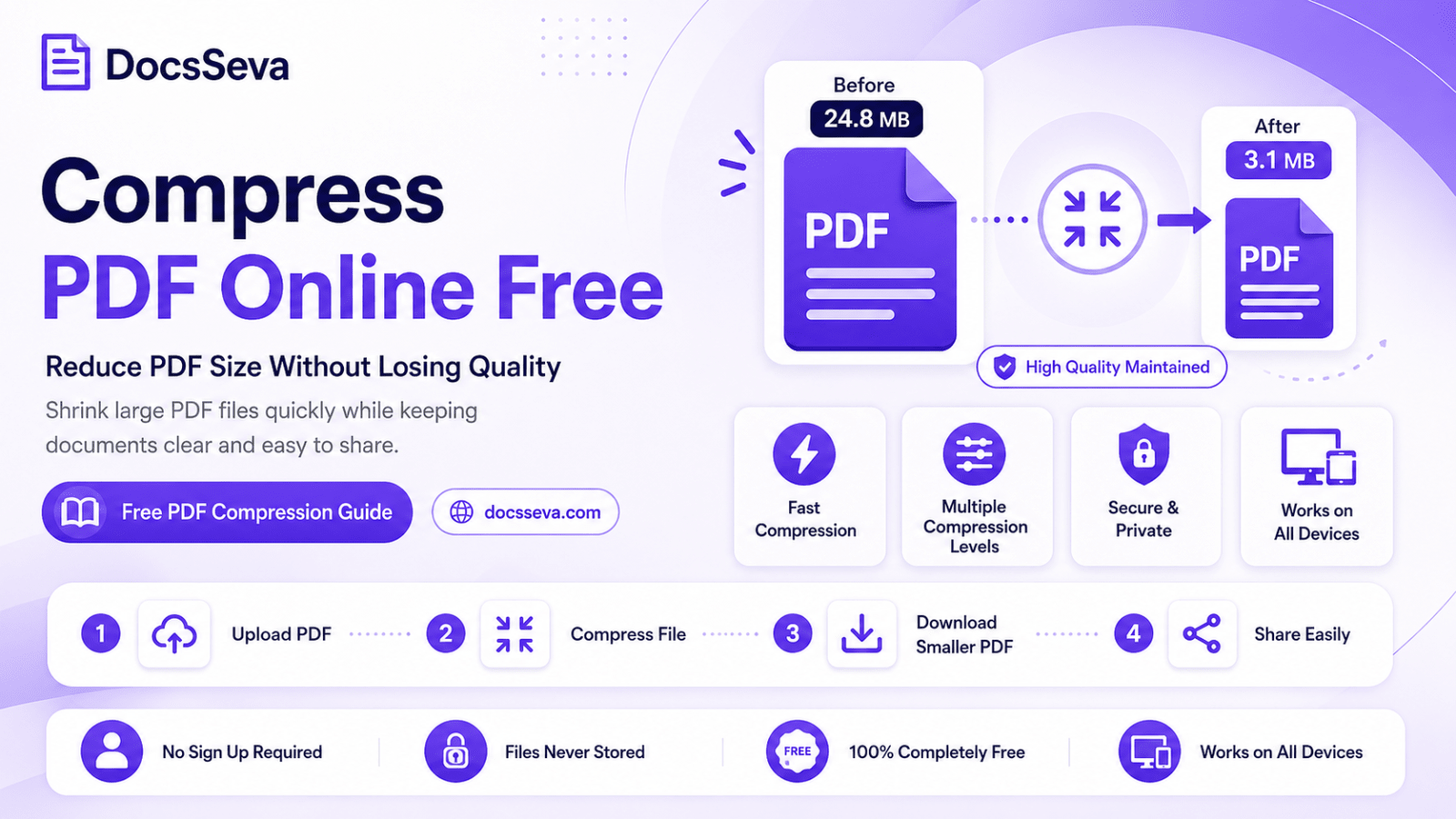
How to Compress a PDF Online for Free: Step-by-Step Guide
Large PDF files can be difficult to email, upload to job portals, submit through government websites or store on your device. The easiest solution is to compress the PDF and reduce its file size while keeping the document readable.
With the free DocsSeva PDF Compressor, you can reduce PDF file size online without installing desktop software or creating an account. You can select a compression level based on whether you need better visual quality or the smallest possible output.
In this guide, you will learn how to compress a PDF online for free, select the correct compression mode and solve common problems such as blurry pages or files that remain too large.
Quick solution: Open the DocsSeva PDF Compressor, upload your PDF, select a compression mode, process the document and download the smaller file.
What Does PDF Compression Mean?
PDF compression reduces the amount of data stored inside a PDF document.
A PDF may contain:
- High-resolution photographs
- Scanned document pages
- Embedded fonts
- Repeated images
- Graphics and illustrations
- Metadata
- Unnecessary document data
A PDF compressor optimises some of these elements so that the final document uses less storage space.
For example, a PDF containing several high-resolution images may be reduced from 20 MB to a much smaller size by optimising those images. The exact result depends on the content of the original document and the compression level selected.
Why Should You Compress a PDF?
You may need to reduce PDF file size when:
- The PDF is too large to send through email
- A job portal has a strict upload limit
- A government website accepts files only below a certain size
- You need to upload assignments to a learning portal
- A scanned document uses too much device storage
- You want faster document uploads and downloads
- You need to share several PDF files at once
- Your website or cloud platform rejects a large document
Smaller PDF files are generally easier to upload, share, download and store.
How to Compress a PDF Online for Free
Follow these steps to reduce PDF file size using DocsSeva.
Step 1: Open the DocsSeva PDF Compressor
Go to the free online tool:
You do not need to create an account or install an application.
Step 2: Add Your PDF File
Drag and drop your PDF into the upload area or use the file-selection button to choose it from your device.
Before uploading, confirm that:
- The document is in PDF format
- The PDF opens correctly
- The file is not corrupted
- You know the password if it is protected
- You have saved a copy of the original document
DocsSeva also provides a batch mode when you need to process multiple PDF files.
Step 3: Select a Compression Mode
Choose the mode that best matches your requirement.
Low Compression
Use Low compression when visual quality is your highest priority.
It is suitable for:
- Professional reports
- Portfolios
- Documents containing detailed images
- PDFs prepared for printing
- Files that need only a small size reduction
Medium Compression
Medium compression offers a practical balance between output quality and file size.
It is suitable for:
- Email attachments
- Job applications
- Assignments
- Business documents
- General online sharing
For most users, Medium is the best mode to try first.
High Compression
Use High compression when the document must be reduced more aggressively.
It is suitable for:
- Strict upload limits
- Large scanned PDFs
- Online application forms
- Documents primarily viewed on screens
- PDFs that remain too large after Medium compression
Always inspect the downloaded file to confirm that small text and images remain readable.
Screen Mode
Screen mode is intended for the strongest file-size reduction.
It converts each page into a page image, which can significantly reduce some documents. However, text may no longer remain selectable or searchable after this process.
Use Screen mode when:
- Achieving a smaller file is more important than editable or selectable text
- The PDF is only being submitted for viewing
- Other compression modes do not reduce the document enough
- You need to meet a strict upload limit
Avoid Screen mode when you need to copy text, search inside the PDF or preserve accessibility features.
PDF Compression Mode Comparison
| Compression mode | File-size reduction | Visual quality | Selectable text | Recommended use |
|---|---|---|---|---|
| Low | Light | Highest | Preserved | Printing and detailed documents |
| Medium | Balanced | High | Preserved | Email and everyday sharing |
| High | Strong | Moderate to high | Preserved | Portals and strict size limits |
| Screen | Strongest | Screen-focused | Usually not preserved | Smallest possible viewing copy |
Start with Medium compression. Move to High only when the result is still too large. Use Screen mode as the final option when file size is more important than selectable text.
Step 4: Start the Compression
After choosing a mode, start the compression process.
Processing time depends on:
- Original file size
- Number of pages
- Number and resolution of images
- Whether the document is scanned
- Compression mode
- Device performance
- Available browser memory
Avoid closing the browser tab while the document is being processed.
Step 5: Download and Inspect the Compressed PDF
Download the compressed PDF and open it before deleting your original file.
Check the following:
- All pages are present
- Text remains readable
- Images are clear enough
- Page orientation is correct
- Links still work where required
- The output file opens without an error
- The final size meets the upload requirement
Always keep the original PDF until you have verified the compressed result.
How to Compress a PDF Without Losing Quality
Every meaningful compression involves a trade-off between file size and visual quality. However, you can minimise noticeable quality loss by following these practices.
Start With Medium Compression
Medium mode usually provides a useful reduction without making the document look heavily compressed.
Avoid Repeated Compression
Compressing the same file repeatedly may continue to reduce image quality without producing a major additional saving.
Keep the original file and create each new attempt from that original.
Remove Unnecessary Pages First
Deleting pages you do not need can reduce the file size before compression.
Use the DocsSeva PDF Page Remover to remove unwanted pages.
Split Very Large Documents
When only a few pages are required, split the document instead of uploading the complete PDF.
Use the DocsSeva PDF Splitter to separate specific pages or page ranges.
Check Small Text Carefully
Documents containing marksheets, certificates, invoices or legal text should be inspected at 100% zoom after compression.
Use Screen Mode Only When Necessary
Screen mode can produce a smaller document, but selectable text may be lost. Use Low, Medium or High when searchability matters.
How to Compress a PDF for Email
Email platforms limit the size of attachments. A smaller PDF is also faster for the recipient to download.
Recommended process:
- Open the DocsSeva PDF Compressor.
- Upload your document.
- Select Medium compression.
- Download and check the result.
- Use High compression if the attachment remains too large.
- Use Screen mode only when selectable text is not required.
For reports, resumes and ordinary documents, Medium mode is usually the best starting point.
How to Compress a PDF for Job and Government Portals
Online application systems often enforce strict document limits.
Before submitting:
- Confirm the maximum allowed file size.
- Remove unnecessary pages.
- Compress the PDF using Medium mode.
- Try High mode when required.
- Inspect names, registration numbers, signatures and small text.
- Confirm that the final file size is below the portal limit.
- Upload the file before the submission deadline.
Do not assume that the smallest file is always the best file. A document that meets the limit but contains unreadable text may be rejected.
How to Compress Multiple PDFs at Once
When you have several invoices, receipts, assignments or reports, use the batch-compression option instead of processing each file separately.
A batch workflow helps you:
- Save time
- Apply a similar compression setting to multiple files
- Prepare document collections for email
- Reduce the storage used by archived files
- Process several scanned documents together
After downloading the results, check each document individually because different PDFs may respond differently to the same setting.
Why Did My PDF Barely Get Smaller?
A PDF may show only a small reduction for several reasons.
The PDF Is Already Compressed
Some documents are optimised when they are originally exported. Recompressing them may offer little benefit.
The File Contains Mostly Text
Text normally uses much less space than high-resolution images. A text-heavy PDF may already be small.
Images Are Already Optimised
If embedded images are already compressed, the tool has less data to reduce.
The Selected Mode Is Too Light
Try High compression when Low or Medium produces insufficient reduction.
The PDF Contains Complex Elements
Forms, embedded fonts, vector graphics and other document elements may limit the achievable reduction.
Why Does the Compressed PDF Look Blurry?
Blurriness usually appears when images or scanned pages are compressed aggressively.
Try these fixes:
- Return to the original PDF
- Select a lower compression level
- Avoid compressing an already compressed output
- Check whether Screen mode was selected
- Inspect the document at normal viewing size
- Use High-quality scans when creating the original PDF
For certificates and documents containing small text, readability should be prioritised over reaching the smallest possible size.
What If the PDF Is Still Too Large?
Try this sequence:
- Remove unnecessary pages.
- Split the PDF if only part of it is required.
- Compress the original file using High mode.
- Try Screen mode if selectable text is not required.
- Reduce oversized source images before recreating the PDF.
- Confirm whether the portal accepts multiple smaller PDFs.
- Check whether another accepted file format is available.
Extremely strict limits such as 100 KB may not be achievable for every document without a noticeable reduction in quality.
Related DocsSeva PDF Tools
After compressing your document, these tools may help complete the workflow:
- PDF Merger — combine several PDFs into one file
- PDF Splitter — separate pages or page ranges
- PDF Page Remover — delete unnecessary pages
- PDF Password — add password protection
- PDF Unlock — remove an authorised password restriction
- PDF OCR — make scanned text searchable
- Images to PDF — convert images into a PDF document
Frequently Asked Questions
1. Is DocsSeva PDF Compressor free?
Yes. You can use the PDF Compressor without creating an account or purchasing a subscription.
2. Does DocsSeva add a watermark to compressed PDFs?
No. The compressed output is downloaded without a DocsSeva watermark.
3. Which compression mode should I choose?
Start with Medium mode for a balance between quality and file size. Use Low for higher visual quality, High for stronger reduction and Screen mode when the smallest possible viewing copy is required.
4. Will text remain selectable after compression?
Text is intended to remain selectable in Low, Medium and High modes. Screen mode rasterises pages, so text may no longer remain selectable or searchable.
5. Can I compress a scanned PDF?
Yes. Scanned PDFs can be compressed, but strong compression may make fine text and image details appear softer.
6. Can I compress multiple PDF files?
Yes. Batch mode can be used to process multiple PDF files in one workflow.
7. What is the maximum supported PDF size?
The tool currently supports PDF files up to 1 GB. Processing very large files also depends on the available memory and performance of your device.
8. Why is my PDF not getting much smaller?
The PDF may already be optimised, contain mostly text or use images that are already compressed. Try a stronger mode, but avoid sacrificing readability unnecessarily.
9. Can I compress a PDF below 100 KB or 200 KB?
You can try High or Screen mode, but reaching an exact size cannot be guaranteed for every document. The result depends on the number of pages, images, scan quality and original file size.
10. Will PDF compression change the page dimensions?
Compression is intended to reduce stored data rather than change the visible page size. However, always inspect the output because different PDF structures may behave differently.
11. Can I compress a password-protected PDF?
A protected PDF may need to be unlocked using the authorised password before it can be processed.
12. Can I compress the same PDF more than once?
You can, but repeated compression may reduce quality without producing a meaningful additional saving. Create each compression attempt from the original PDF.
13. Is it safe to compress confidential documents?
Review the tool's current privacy information and your organisation's document-handling policy before processing sensitive legal, financial, identity or medical documents.
14. Does PDF compression remove links?
Standard compression should normally preserve document structure, but links should always be tested in the downloaded output before sharing it.
15. Does the tool work on mobile devices?
The online tool is designed to work through modern browsers on desktop, tablet and mobile devices.
Start Compressing Your PDF
A PDF does not need to remain unnecessarily large. With the correct compression level, you can make documents easier to upload, email and store while maintaining acceptable readability.
Open the free tool below, select the appropriate compression mode and download your smaller document:
Compress PDF Online for Free with DocsSeva
Always inspect the downloaded PDF before submitting it to an important portal or deleting the original file.
DocsSeva Editorial Team
Published on July 22, 2026 · Updated on July 28, 2026
Browse all tools
29+ free document tools, no account required.
Browse all toolsRelated articles
In-Depth How-to Guide
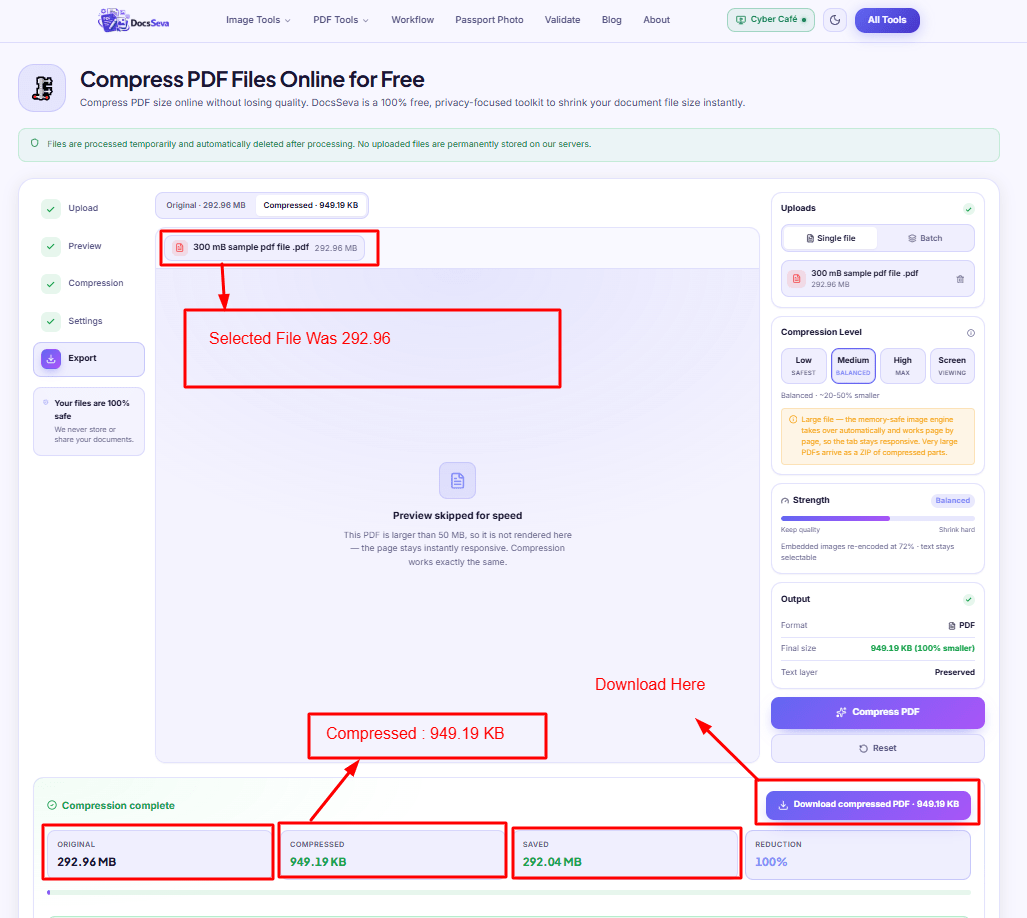
Compress a 300 MB Scanned PDF Without Freezing the Tab
A 180-page, 312 MB scan crashes the tab and comes back as a ZIP. Why that happens, what each level does to your pages, and the cheaper step to take first.
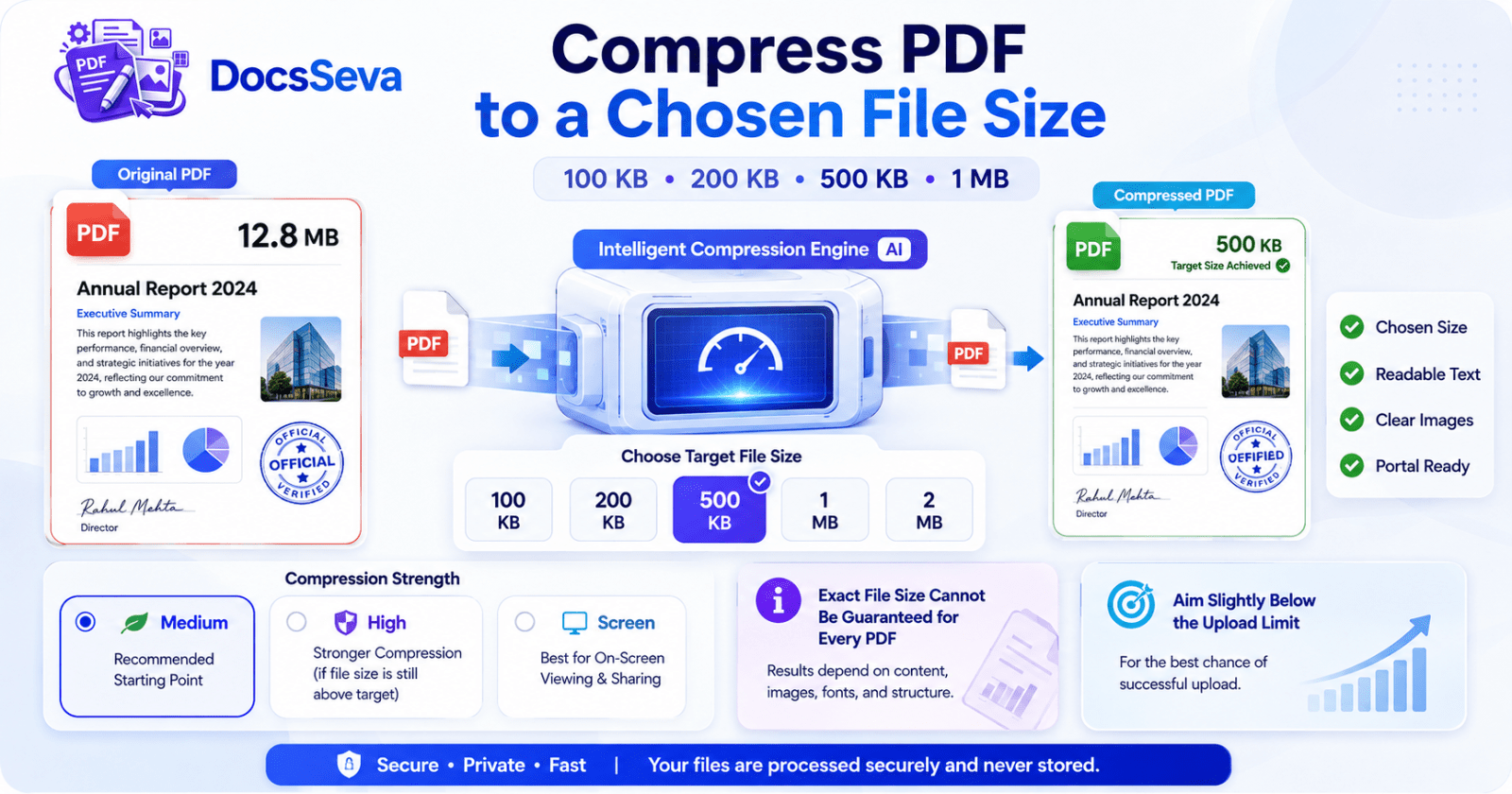
How to Compress a PDF to a Chosen File Size Without Losing Quality
Learn how to compress a PDF to a chosen file size such as 100 KB, 200 KB, 500 KB, 1 MB or 2 MB while preserving readable text, clear images and essential document details.
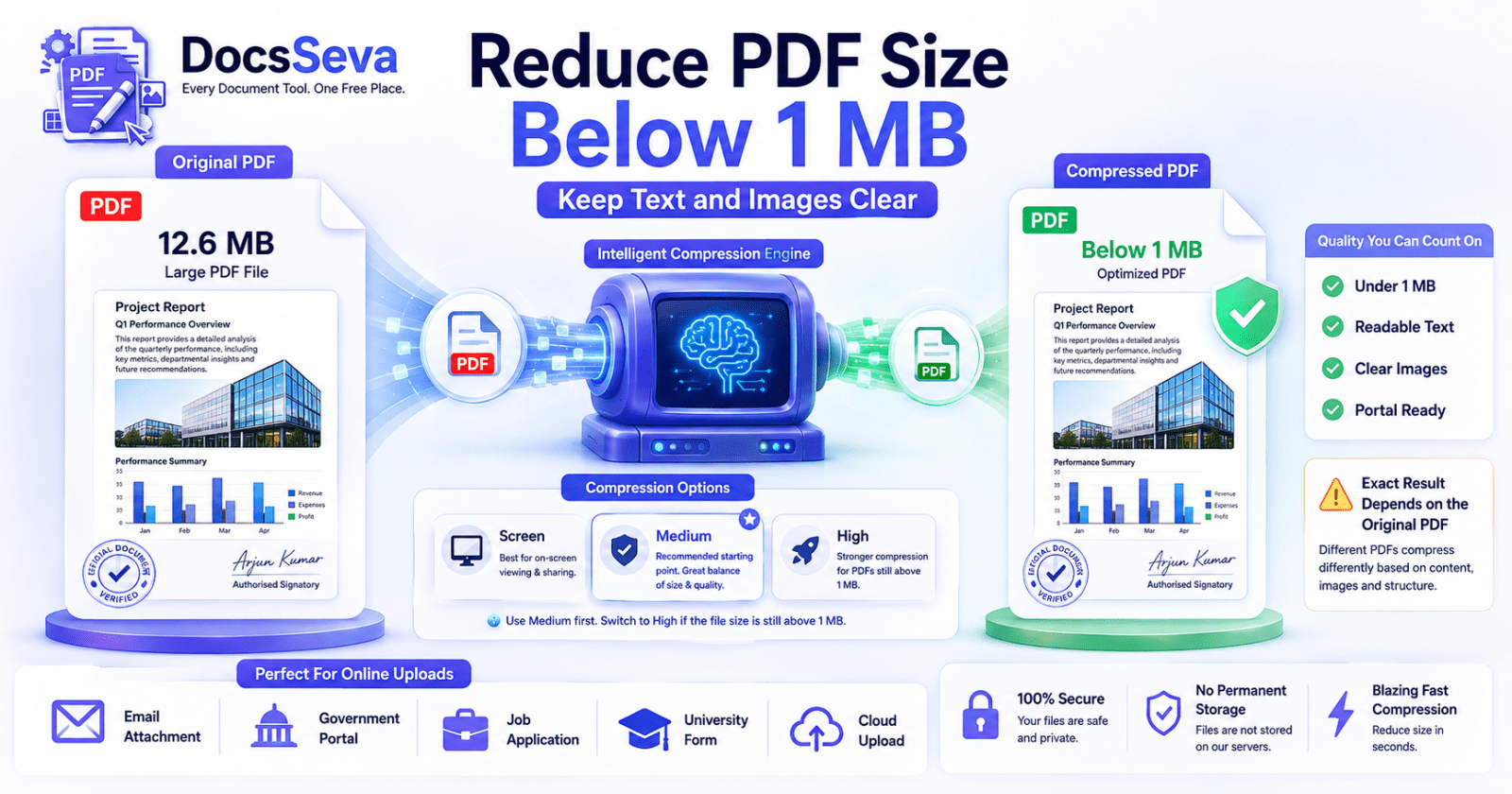
How to Reduce PDF Size Below 1 MB Without Losing Readability
Learn how to reduce PDF size below 1 MB for email, government portals, job applications and online forms while keeping text, images and signatures readable.